
What Does 420 Mean For Black People When We Own So Little Of The Cannabis Industry?
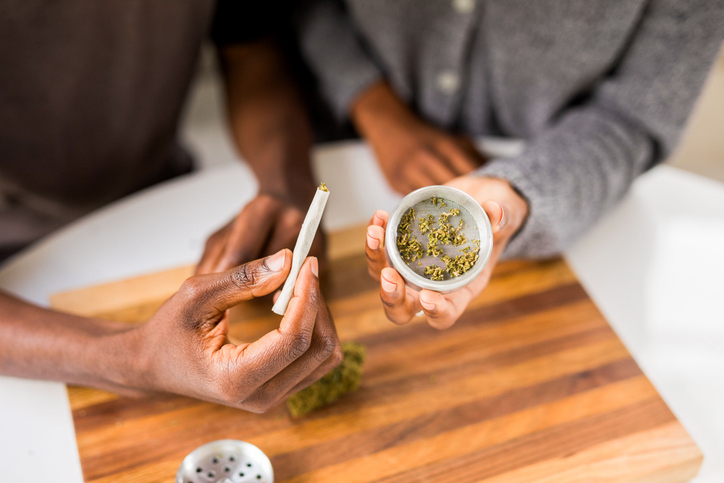
When it comes right down to it, 420 is an arbitrary holiday. For those who already smoke cannabis regularly, we might as well be celebrating “Wearing Pants Day” or “Drinking Water Day.” (Happy 4H20, anybody?) Even the origin story about how 420 came to be is mundane.
So, back in the ’70s, a bunch of high school kids got together at 4:20 p.m. to smoke weed, and from that, the date of April 20 became the representation of this counterculture phenomenon that, again, only celebrates people doing what many of them already did the other 364 days of the year?
For Black people, though, 420 can and has served a purpose, because every year, on April 20, Black media, Black academic circles, and Black people who have been arrested one too many times for the possession or sale of “marijuana” discuss one issue more than anything else: Black ownership in the legal cannabis industry — or lack thereof.
But before we talk about the need for more Black-owned cannabis dispensaries and brands, let me share this excerpt from what we discussed regarding 420 last year:
Before it was ever labeled “marijuana” and demonized by politicians through fear-mongering propaganda, cannabis was a respected medicinal and industrial plant. Early American presidents grew hemp for rope, textiles, and paper. For centuries, the plant was used to relieve everything from nausea to anxiety. It wasn’t until Black jazz musicians and Mexican immigrants brought cannabis into the mainstream in the early 20th century that the government got nervous. Why? Because it was now associated with us.
Fast forward to the 1970s: Nixon doubled down, calling weed “public enemy number one” and signing laws that lumped marijuana in with heroin and LSD. That move, paired with the War on Drugs, decimated entire neighborhoods, putting Black men and women behind bars at staggering rates for the same plant that’s now being sold in luxury dispensaries with sleek branding and big investor backing.
So, what does that mean for us today?
It means 4/20 is more than a holiday; it’s a call to action.
Black people are used to living in a world where we can almost hear the collective groaning and eye rolling of white people whenever we bring up racial disparities in any industry, or in the degree to which certain communities are policed and others are not. “Why can’t we just celebrate and not make everything about race?” — would be the most predictable response we could expect when we bring up the facts that we represent roughly 13% of the U.S. but only account for 1.2% to 1.7% of business owners in the industry, or the fact that, before cannabis became recreationally legal in nearly half the states in the country, Black people were 3.6 to 3.7 times more likely to catch a possession charge than our white counterparts.
So, to recap: “Marijuana” became stigmatized in the first place because Black and Latino people made it trendy. Once it was stigmatized and made illegal, Black people were disproportionately arrested and jailed for it, and now that it’s legal in half the country and decriminalized in most states, it has become a booming industry that Black people have next to no ownership in.
Black people truly only have one reason to celebrate 420: to promote the existing Black-owned cannabis businesses and brands and to advocate for more of them — much more.
More from our previous 420 post:
THC Co. is Washington State’s only Black-owned cannabis farm. This multigenerational business prioritizes sustainability and community by buying locally and utilizing solar energy to create high-quality products.
Mellows is a Black-owned cannabis edibles brand that specializes in crafting some of the tastiest, most unique marshmallows you’ve ever tried. Each one of these gourmet chews contains a mellow dose of THC coming in at 5 mg.
Precious Canna Co. is a Black, woman-owned luxury cannabis brand based in New Jersey that offers the best pre-rolls you’ll have all year.
Viola is the largest Black-owned premium cannabis brand, owned by Al Harrington. Named after the NBA star’s grandmother, Viola, who benefited greatly from cannabis consumption during her battle with glaucoma, you can find Viola cannabis products in several states across the country, including Oregon, Nevada, California, Arizona, Colorado, Michigan, Pennsylvania, Florida, New Jersey and Canada.
Noirebud is a female-owned and operated CBD brand that promotes trustworthy, affordable, high-quality products of varying types. From herbal teas to topicals and even cannabis fragrances, Noirebud is an amazing Black-owned brand to spoil yourself with.
You can also find more Black-owned brands and dispensaries here, here, here and here.
We encourage you to do your own research and find more brands and businesses to add to the list of sources.
Again, this needs to be the focus for 420 for our communities: support what exists, and campaign for us to own more of what we made cool in the first place.
SEE ALSO:
420: Why It’s Time to Celebrate Cannabis and Black Advocacy
Black-Owned 4/20-Friendly IG Accounts To Follow
DEA Could Reclassify Marijuana
8 Black Celebrity Cannabis Brands You Should Know
Black Americans: Pay Attention To The ICE Raids In Oklahoma


Post a Comment
0 Comments