
Black organizers and communities are no strangers to extremists and dealing with hostile state and federal governments. And Trump’s latest Mad King impression has 2026 feeling less and less like a so-called democracy and more like a dystopian nightmare.
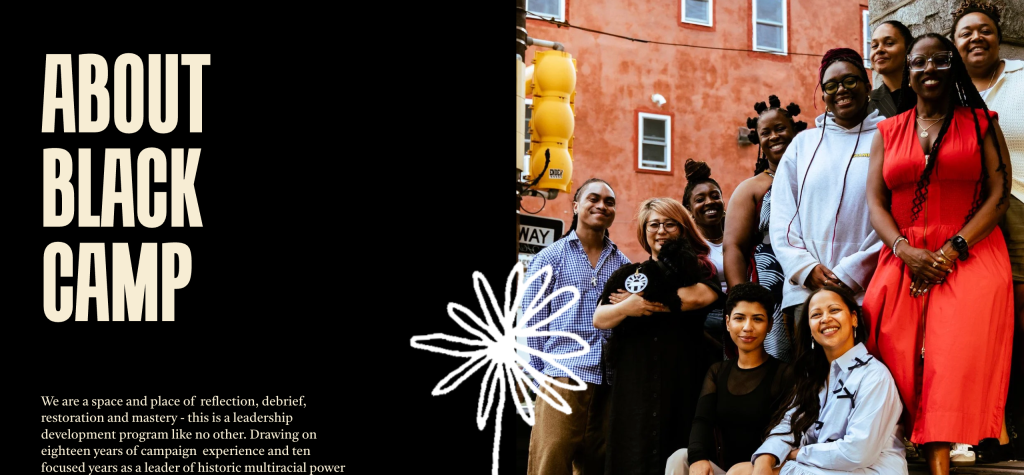
Even as institutions are fracturing and people are exhausted, people like veteran political strategist and organizer Jessica Byrd are building space for visioning new possibilities. In its second year, Black Camp provides a third space for people who are trying to do more than just survive the Trump apocalypse.
Black is making space for shared strategy and community restoration
Speaking with NewsOne, Byrd said that beyond talking about the upcoming election, it’s important to get real about what survival looks like. Less conference, more survival infrastructure: Black Camp is a place of respite and planning.
“We know something is coming that is putting all of us at risk in this country, which means that Black people are more at risk than anyone else,” Byrd said. “And so we not only need to be talking politically and electorally, we have to talk about survival in this moment.”
A seasoned campaigner, trainer, and movement fairy godmother, Byrd’s journey to Black Camp wasn’t accidental. Reflecting on her over 20 years of experience with electoral campaigns and political powerbuilding, she said the conditions shifted beneath her feet.
Starting as a volunteer at 17, Byrd had spent nearly 20 years registering voters, building political power, and training candidates and campaign staff. But post-2020, the landscape shifted.
“I couldn’t keep electing people, and I certainly couldn’t keep training people to engage electorally without actually addressing and stepping back at the new conditions that we’re all in,” Byrd shared.
Reflecting on her upbringing as a poor kid in Columbus, Ohio, Byrd said that part of her theory of change was being in community with people who made sure folks had what they needed.
“I really needed my community,” she said. “My community was full of Black women leaders, and they took care of business like everybody was fed.”
Her orientation toward providing for the community came from growing up knowing that, for many, a relatable experience was attending activities at the recreation center, where everybody was taken care of, and you knew people loved you.
Emerging from the pandemic and looking at the political landscape, she thought hard about how everything we experienced during the pandemic changed how we showed up in the world. And that included the electoral and advocacy spaces she had been a part of.
Black Camp emerged as “a container for that dialogue”—a space to acknowledge the unprecedented renaissance of Black leadership over the past decade while preparing for challenges that voting alone cannot solve.
Black Camp offers a masterclass in moving from analysis to action
Ahead of the 2024 election, Byrd convened a cohort of Black movement leaders at Alex Haley’s family farm in Clinton, Tennessee. It was set up as a kind of “Black Camp David.” But after Trump’s election, Byrd realized she couldn’t just bring people to one location in Tennessee.
She knew it was important for people to have that same supportive experience in their own communities. Now in its second year, Black Camp will host gatherings in Philadelphia (April 15-18), Atlanta (June 17-20), Columbus, Ohio (September 9-12), and Las Vegas (September 17-19).
Tailored to the local flavor and experience, each camp will blend community, wellness, and dialogue through masterclasses and open sessions. Byrd described four core areas of focus: grounding in the State of Black America, world building, community care and survivalism, and systems and power.
“My greatest hope is that people have the type of dialogue they can’t have other places, because they’re scared to say things like, ‘I’m worried we’re in a Civil War. I’m worried I’m going to a parade and there’s going to be a bomb,'” she said.
What distinguishes Black Camp from typical leadership training is its refusal to accept a scarcity mindset. Byrd shared that Black leaders have been gaslit by the existing ecosystem, while their organizations struggle to make it happen.
“I want people to leave and be like, ‘Oh yeah, that’s my home base. I’m going back there every year,’ Byrd said. “I’m going to make a new plan for my leadership. I’m going to change my organization.”
Holding space for hope and urgency
The last 10 years have produced an “incredibly real and important Renaissance of Black leadership in Black political work,” Byrd said. The ecosystem of Black organizing and Black leadership has grown.
She said it’s not quite at the scale we need, but it has brought people together with a shared commitment and understanding of how to move forward. Byrd’s goal is for Black Camp to resource and build the infrastructure for a movement that understands that survival and strategy are the same work.
The chaos isn’t going anywhere, but neither are the doers. And for those who need a place to pause and reflect, Black Camp is the infrastructure to help develop the tactics and strategies to meet the unprecedented threats of the moment.
“If you have that feeling in your heart like, ‘I think I could have something for this moment,’ then I made a camp for you,” Byrd said. “If you see yourself inside of this Renaissance, if you see yourself as reimagining this whole place, then this Black Camp’s the place for you to be.”
SEE ALSO:
Black Professor Sews Quilt Honoring Civil Rights Activist Fannie Lou Hamer
Snap On Sneed! Rookie News Anchor’s Memphis Roast Goes Viral


Post a Comment
0 Comments