
Nina Simone, Sam Cooke, And What Black Artists Sacrificed To Make Pro-Black Art
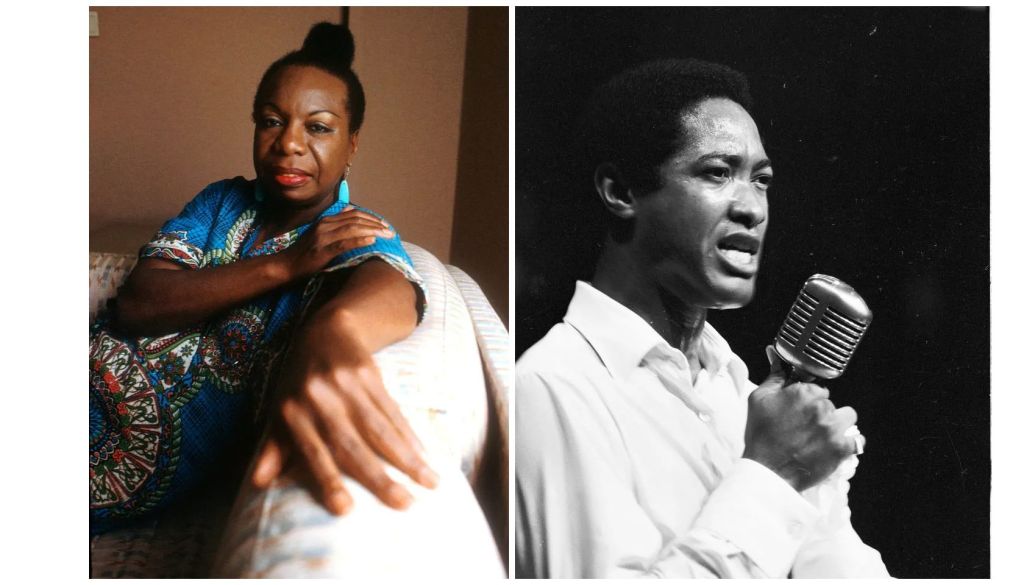
June is, among other things, Black Music Month, and if we’re going to talk about Black music, we have to talk about protest music. But if we’re going to talk about protest music, we have to talk about sacrifice, and if we’re going to talk about Black music, protest music and what was sacrificed to make it great, we have to talk about Nina Simone and Sam Cooke, two artists who decided the message was more important than their commercial success.
And they decided it was damn sure more important than the dangers of pissing off white folks.
“I’ll tell you what freedom is to me: no fear. I mean, really — no fear.”
Simone said that in 1968, after an interviewer asked her what freedom meant to her.
In the 2015 Netflix documentary, What Happened, Miss Simone? — a title that quoted an essay written about the singer/songwriter by Maya Angelou in 1964 — Simone’s daughter, Lisa Simone, explained that when her mother gifted the world with her 1964 song “Mississippi Goddam,” DJs refused to play it, and “boxes of the 45s used to be sent back from the radio stations cracked in two.” The song — which she famously performed during the 1965 march from Selma to the steps of the capitol in Montgomery, the event that resulted in what is referred to as “Bloody Sunday” — was considered to be Simone’s “first civil rights song,” according to journalist Ruth Feldstein, who wrote in her editorial titled, “I Don’t Trust You Anymore”: Nina Simone, Culture, and Black Activism in the 1960s, that the song was composed in less than an hour, and emerged in a “rush of fury, hatred, and determination” as Simone “suddenly realized what it was to be black in America in 1963.”
But it certainly wasn’t her last civil rights song, as it was followed by other protest songs, such as “Four Women” (1966), “Ain’t Got No, I Got Life” (1968), and “To Be Young, Gifted and Black” (1969).
“An artist’s duty, as far as I’m concerned, is to reflect the times. I think that is true of painters, sculptors, poets, musicians…I choose to reflect the times and situations in which I find myself. That, to me, is my beauty. And at this crucial time in our lives, when everything is so desperate — when every day is a matter of survival — I don’t think you can help but be involved. Young people, Black and white, know this…we will mold and shape this country, or it will not be molded and shaped at all. So, I don’t think you have a choice…How can you be an artist and not reflect the times?”
Now, let’s talk about Sam.
According to PAM (Pan-African Music) writer Elodie Maillot, Sam Cooke’s first big hit, “You Send Me” (1957), sold more than 2.5 million copies and put him on the road to being among the first Black American artists to reach heights of stardom comparable to that of Elvis Presley. Ironically, though, the song he’s arguably most known for, “A Change Is Gonna Come” (1964), was one that threatened his standing with mainstream (read: white) America, to the point where it was initially released by RCA without the iconic line, “I go to the movies and I go downtown/ Somebody keep telling me don’t hang around,” because those lyrics referenced the Jim Crow South, and one thing that remains unchanged in this country is white people’s intolerance for any truthful, non-whitewashed telling of U.S. history.
In fact, it was that very history that inspired the song in the first place.
From PAM:
‘Being a successful musician wasn’t enough for Cooke. I was also sick of scoring and winning matches’ says footballer Jim Brown in the Netflix documentary “The Two Killings of Sam Cooke”. ‘When you become a crossover celebrity in this country you wonder whether you should be careful or if you should speak the truth and get involved?’
Cooke never disowned his Black audiences, nor denied that there were problems, but one event in particular made him cross the Rubicon, and pushed the voice of an angel to call for change.
In 1963 Cooke arrived at a Louisiana hotel where he had made a reservation by telephone. Upon seeing him, however, the receptionist denied him access. A scandal. Cooke’s wife advised him to let it go and leave. ‘No, we’re not going to leave and no one can kill me, I’m Sam Cooke!’ replied the singer.
That night “A Change Is Gonna Come” came to him in a dream, the only song to have come to him in this way. Cooke was so afraid that it took him a year to finish the song. He entrusted the almost symphonic string arrangements to Renée Hall. Those rich violins of the intro are in sharp contrast with the raw reality at the beginning of the song which tells the story of an entire country. ‘I was born near a river in a little tent…I’m afraid to die’ sings Cooke. He was being both threatened by the KKK and harassed by the music mafia because of his attempts to set up an agency that would bring artists together to protect their rights and place them at the heart of the lucrative music business.
Cooke famously refused to play for a segregated audience in Memphis in 1961. By the mid-’60s, he had publicly befriended Brown, Malcolm X, and Cassius Clay, who later became Muhammad Ali, all of whom were active in the Civil Rights movement. Before he was murdered under somewhat mysterious circumstances on Dec. 11, 1964, Sam, like Nina, was an artist, a musician, an activist, and, before all of that, a Black man who cared about his people and knew that our collective betterment represented a cause that was bigger than his career.
Simone and Cooke weren’t alone, of course.
Billie Holiday released the anti-lynching anthem “Strange Fruit” in 1939, and racists warned her to stop performing it. She didn’t. James Brown’s “Say It Loud, I’m Black, and I’m Proud” (1968) was an anthem of pride and rejoicing for Black America, but white radio stations boycotted it, and Brown’s predominantly white crossover audience turned on him, ensuring the song would be his last top 10 pop hit. And it’s still one of his most iconic songs today. Bob Marley, who dedicated his life to activism through song, was shot over his public resistance to oppression and influence in Jamaican politics. These are just a few of the countless Black artists who sacrificed for their art.
So, why is all of this so important now?
Well, what has changed, really? Sure, on paper, Black people have more rights now than we had in the ’50s and ’60s, but our vote is still being threatened, our history is still being erased by white people for white people, and the current federal administration has done more to make white nationalism great again than, arguably, any post-Civil Rights era commander in chief. As artists — as painters, sculptors, poets, musicians — how can you not reflect these times in your work?
Even here at NewsOne, we aim for our reporting to reflect the era in politics, socioeconomics, and Black culture in which we find ourselves. Now, there are those who tell you that journalism and activism should always be separate, but that’s only because those people are afraid of both.
We do journalism that reflects the times, because that’s our job. As an artist, what’s your job? To entertain? To inform? To tell a story? To tell your story? What will be the motivation for your next song, poem, or painting?
And to spread your message freely and unapologetically, what are you willing to sacrifice?
SEE ALSO:
Where Are The NWAs? A Call For The Return Of Protest Music
Drapetomaniac Music: The Soundtrack To Black Liberation


Post a Comment
0 Comments